
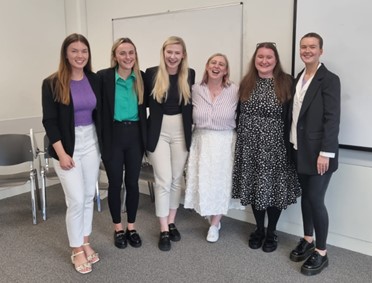
In this conversation five amazing newly qualified teachers talk with me about how they used dual coding theory to improve engagement in language learning for students with dyslexia. They share their own professional journeys in undertaking this research, make recommendations for the future and speak about the importance of inclusion in learning, teaching and assessment.
Resources from this episode
Book: Mental Representations: A Dual Coding Approach (Allan Paivio)
Transcript of this episode
SUMMARY KEYWORDS
Dual coding, students, dyslexia
SPEAKERS
Eimear, Laura Keegan, Laura O’Neill, Tara, Órla, Mags
Mags 00:00
Welcome to talking about all things inclusion, a podcast where I get to meet and learn from people in the field of inclusion in its broadest sense that inspire me. I hope they inspire you to. Today, I’m talking with a group of inspiring almost newly qualified teachers, who as a group took on the task of exploring how to support students with dyslexia in their classrooms, or language teachers, I would like to introduce today’s guest in returning Laura Kagan, Oregon, Magna bola, Laura Neil, and Tara Quinn. Ladies, I have had the privilege of accompanying you on this research journey, as part of your professional master’s in education, and your commitment to including all of your students in your language classes. And making languages accessible to everyone is so inspiring. You chose to look at the potential of dual coding theory to support the teaching and learning of students with dyslexia through a whole class approach. And I’m delighted to have you with us today to share you, your and your students learning journey with us.
Laura O’Neill 01:10
Thank you, Mags, we’d all just like to say thanks a million for inviting us along today. It’s our pleasure to come and talk about all things dual-coding with you and talk about our personal experiences in the language classroom. So we’re looking forward to our conversation.
Mags 01:25
Its an absolute pleasure to have you here after working with you all year. I always say to my guests, this is an easy question. And then they tell me that it’s not, but you start off by telling us a little bit about yourselves. And what led you to this inclusion path. And specifically, this wonderful piece of research on dual-coding theory to support teaching and learning.
Laura O’Neill 01:49
Yep, so we are a group of five almost newly qualified teachers, just finishing our Masters of Education in Maynooth. University. So we’re all language teachers with a mix of modern foreign languages, Between us we have French, Spanish, German and Gaeilge. So with only two years of experience as language teachers in our own schools, so just placement experience, we had already noticed that students with dyslexia were struggling to keep up with the pace of our classes. And the same students were struggling with the retention of new vocabulary. And because of this they were oftentimes disengaged and had no interest in progressing further with their learning of the language. So as part of our PME, we were asked to conduct research and to write a thesis on an educational area of interest to us. So we took this opportunity to explore dual-coding theory, and implemented in our classrooms and pretty much see what happened. See how we will get on. That’s what we did.
Mags 02:45
Super, thank you. That was Laura O’Neill speaking there and Laura as you were speaking, three words jumped out at me, pace, retention, and most importantly, engagement. Would any of you like to talk about that, and how it wasn’t there, and perhaps how it was there after you finished your research?
Laura Keegan 03:09
Yeah, I’m Laura Keegan. And in terms of engagement, I think that we all found in our classes that especially students with dyslexia, were really just struggling in general, I think which, again, with keeping up with the pace, but also because of that, they were becoming very, you know, feeling demotivated in class, and it was just leading to them, basically not wanting to take part in the class whatsoever, which is, it’s very difficult to kind of see that because you want to be able to feel like you can provide, you know, the best you can for the students so that they can involve themselves in the class like like their other their other classmates,
Mags 03:48
When you were talking there you were talking about yourselves as teachers and how you want to provide the best you can for your students. I think this is where when you went searching for the best you can, you came up with dual- coding theory, can one of you or a few of you explain what dual-coding theory is to other teachers out there.
Eimear 04:12
Hi, I’m Eimear. Dual-coding theory states that when we use both the visual and the verbal, students with dyslexia tend to retain information better, and they tend to acquire language better. So it’s like the brain can process the information more easily when they have both a picture of a dog and the word in the target language in French and Spanish in German. And then this from our research like shows that there’s better comprehension, there’s better recall, there’s better retention and then that again, leads to what Laura Keegan was saying that, by them succeeding in those parts they go on and they feel more motivated. They feel included in the class. They feel like they’re making progress and then it’s all like a chain, a cycle where they get better and better and better.
Mags 04:57
OK, so visual and verbal text, give me give me give me a concrete example. What would that look like in my language class,
Órla 05:07
For example, over my. sorry, this is Órla. For real example in my language class in my six classes, we were studying, we were studying áiseanna i mo cheantar, which are facilities in my area.So visual and verbal texts, what my class looks like, was a photograph of a local shop. So the word síopa. So the students were provided with the photograph, they had the word síopa underneath. S i fada, O P A. And they were also made repeat the word over and over again Síopa is maybe a more simpler example, it got more. It was more advanced than that there was words like teach torna. Yeah. And when we were doing school subjects – Eacnamaíocht Bhaile – longer words and things like that. And they were provided with an image of it. They were provided with the word they were made repeat again. And again, our intervention last six weeks lasted six classes, we we all agreed that we could have done with longer, it was just the timeframe we were given. And that is essentially what is involved. So from week one, where we did our pretest, we checked what our students, we looked at their prior knowledge, it was traditional testing with no pictures to week six, where we had used our pictures during our intervention, we did see significant increases in their vocabulary retention, and their morale and their enjoyment of classes. Okay, so this was a six week intervention. And I like how you started with a nice, easy one, you said it wassíopa. So you as a teacher, you didn’t just jump in and say, Oh, we’re now doing dual coding theory. And here’s all the visuals and the complicated words. Break it down step by step for us how you did this with your students, because I know, this was very much co- construction with your students as well.
Mags 07:05
When you were talking it was lovely, where you commented on how your noticed students actually started to take an ownership they started drawing in the pictures into their own copies, which wasn’t part of your plan. What other proof is there that the students actually started enjoying or engaging in or staying motivation more in your lessons?
Tara 07:05
So this is Tara here. Ahm we basically just taught as normal, I think the students weren’t really aware, we tried to not make a big deal out of it, we just said we were going to try something different. Because when we had to get their consent, you know that we were doing this as part of our training, teacher training. But um, so as long as I mentioned, there, we had a pretest. So that was just a normal chapter tests that we did like what would usually be done, and there was no emphasis on pictures, that was just words, vocabulary, it’s kind of what they’re used of what they were saying. And when they’re doing tests for vocabulary and language classroom. And then we know, you know, we started kind of easing them into using more pictures in our PowerPoint presentations and worksheets just in the class in general, we limited the amount of text that would be on PowerPoint presentations. And we made it much more visual classroom, even from their homework, their worksheets, everything. And I think a few of us noticed as well, like students would start drawing the pictures into their notes or drawn stuff into their copies in the middle of assuming that or maybe around like week 2,3,4 Or class, sorry, 2,3,4, then by the end of it, so we were we got rid of our traditional testing and just use pictures as a way of testing the kids rather than what we did the first time. And, yeah, we just saw a significant increase in their test results, well the majority Now overall, we had an increase, we had, of course, we had one outlier who kind of stayed the same. But there may be other reasons for that, too. Okay.
Eimear 09:06
I think, its Eimear here, one thing I noticed was that they were so much more vocal in classrooms. So in my language class in Spanish, we would go through the vocab, I was doing el pasatiempos, which is hobbies and pastimes. And we will go through the vocab. And they were some of the first students have their hand up like some of them almost jumping out of their chair with competitiveness to be the one to showcase to their friends, that or to showcase to themselves even that they knew the answer. And it was just, it was a fantastic thing to see and just that they felt confident themselves before that they would have never spoke Spanish in front of their peers or in front of me without a lot of encouragement with with even a push at that stage even to say kind of go to the bathroom My name is so to just see them be confident in themselves and and confident to speak about their periods with Just it’s fantastic. Yeah,
Tara 10:01
I think I have to definitely agree mine was the same. So I know myself. So this is Tara, Laura O’Neill and Órla McNabola are Irish teachers. So we were saying that we know students right away before they come into the classroom, they kind of have a little bit of a hatred, maybe towards Irish and just don’t really want to learn it or do it. But we noticed definitely while I definitely did in my class, how they were shouting out the answers, they felt more comfortable. Because if they saw a picture, like say, was a cow on the board and bó was your word, they know straight it, but cow cow, you know, they’d say it themselves rather than sitting back thinking, okay, right, I know what not even try, there are definitely more engaged in every lesson. I would agree with that and more student voice in the lesson.
Mags 10:46
And I know that all of this was coming up to the test. And even when you were talking, you said that it wasn’t traditional testing, but it was visual testing. And we talked a lot over the over the year about what students really know, when they can communicate in a way that shows less than show what they really know, compared to the traditional testing, how did you find that in your work, what they really know, compared to that traditional test?
Tara 11:19
Okay, so that puts me in mind of the saying, I’m testing a fish on its ability to ride a bicycle, or something like that. And yeah, so the the testing that took place at the end of our intervention was based totally on the topic we had taught in those six classes. And so the goal for our end tests was we wanted to see what vocabulary they had retained from the subject we had just covered with them. And so the post testing the end of intervention tests looked like an image within with an empty space. So like Eimear’s example earlier on a picture of a dog on an empty space for them right to write any dog in the target language. So that’s what we were testing for. It was it was vocabulary attention, it wasn’t their ability to regurgitate something that they’d wrote. They had rote learned off by heart a big paragraph or something like that, which often happens in language classes, especially in Irish, when the students don’t know what’s really going on. But they want to know, they want to do well in the subject to just tend to rote learn. So I don’t know, the test, the testing we did at the end of the intervention, maybe wasn’t the best test students on all range of abilities, because maybe, maybe the recording doesn’t work for everybody. But it did an excellent job of, of determining whether or not the students vocabulary retention in the target language had improved or not. And that was the name of the game for us. So absolutely.
Mags 12:40
I think it’s a good point where you say your recording may not be best for all aspects. And it goes back to this was intentional, this was for vocab retention, and that perhaps you’d have to look at another approach for something else. And it also brings to mind for me that up until now, we have been talking about your students with dyslexia. But you didn’t differentiate this for students with dyslexia. You offered this to every student in your language class. Can you speak about that?
Laura Keegan 13:11
This is Laura Keegan. And absolutely, although we were just testing the results of the dyslexic students, but that I think, was purely because of our time constraints, and even word count of our thesis. But it was through a whole class approach. So all students were incorporated in the process. So they were learning true dual coding theory also. And at the end of our six week intervention, we also give a student survey to each of our classes asking them, did they like the use of images in their class? Would they like to continue using it and I think we had maybe around 100 students surveyed at the end, and the majority of students all showed a preference for for the images being used. They said it made class more fun. It was easier, easier to learn with the pictures. And I think that’s kind of the beauty about the recording is that they’re really kind of when they’re trying to think of the word they can just imagine the picture, and it really does help with their retention and acquisition of the language,
Mags 14:13
Lauar O’Neill did you want to come in on that as well?
Laura O’Neill 14:16
Yeah. This is Laura O’Neill speaking. I know that I said earlier, doing coding might not work for everybody. But I will say that based on our experience, I think we’d all agree that it is somewhat of a catch all method of teaching like and of course nothing is going to appeal to absolutely everybody but on the whole in the majority. Our results after post testing show that nearly all students improved and the vocabulary tension. Again, it’s not going to work for everybody but we do what we can it really it helps them the majority of students nearly all students made an improvement from pre to post test results.
Mags 14:51
So up until this point, we’ve been talking about your student because that’s why we all go into teaching, but a reminder that you were student teachers doing this piece of research. So what was your key learning from this?
Laura Keegan 15:07
I think for me personally, it’s really to just think of the importance of catering for all student needs. Because I think it’s so lovely as a student teacher or any teacher, to be able to see, your students who maybe do have a special education lead to see them driving in class become more engaged. And I think it really does make you think about the importance of just, you know, implement and implementing different steps in order to help them, you know, succeed in the class. And I think, often kind of with time constraints and busy timetable or something like that can often, you know, it can seem like an arduous task to in order to do that. But I think really, it’s worthwhile when you see the positive results at the end of it.
Laura O’Neill 15:53
The big takeaway for me, I feel would be to really get to know your students that it’s not always just the students with an official diagnosis that are struggling, really good point.
Eimear 16:03
As part of our -it’s Emear- aprt of our piece, we had 11 students with dyslexia, but I could definitely say there was two more kids in my, to my students in my class, that don’t have an official diagnosis, but are really struggling. And they were they weren’t included in the findings for our thesis. And I could, there was an improvement in their grades as well. So it is a while it might not work for everyone. And it does, it does have some. So I think that’s important as well.
Laura O’Neill 16:33
Another big takeaway for me would be if at the end of our research, the scores, the test scores hadn’t improved drastically from beginning to end, I still would have regarded the whole research project as a success, because there was such a jump in the morale of the students, and their willingness and their participation, even if they weren’t retaining more vocabulary than before we implemented dual coding there. They were, they’re going to learn more, because they want to be there, they’re sitting up straight, or they’re engaged, they’re looking at the board, they’re waiting for what’s coming next, even if scores have never improved, that was a huge success. And, and it’s,
Tara 17:15
I think it was, well, we learned the importance as student teachers to have less teacher voice. So we said in one of our observation sheets that we noticed, you know, students weren’t really talking up in class, and they were kind of nervous, whatever to say, in the target language. But it’s so important to have so much student voice in the class, I didn’t always have because they’re more engaged, because they’re finding it more interesting, they’re more likely to talk up, and the class even goes quicker. For us. It’s less strenuous on us as teachers, you know, and it’s more enjoyable for everyone, including us, as teachers, when the students are actively involved, you know, you can sit back and know, that they are learning, they’re, they’re doing this off their own back, you know, it will definitely key and help them to be better learners, when they get to leave on certain level and know how to look after and learn for themselves to work.
Órla 18:08
On the points that the girls made there have I agree with them on something I really took away from it that I wasn’t expecting was when like the example that I mentioned, when we were studying Asha, MacArthur at local facilities, and having actual photos of local areas and things important to the to the students themselves, and spikes a huge interest in them as well, instead of going online and finding a random photo of a sharp, I actually went up the town and took a photo of their local shop that they ran every day after school. And when the photo flashes on the screen, you see the heads turning, you know, they’re they’re so excited that their local shop is on there’s something so small and so simple. And then when it came to mechanic, I’m sharing my past times, I had a photo of their own club, the local club here, and it was their their crest and their jersey that I used and a few neighbouring clubs as well. And they were so excited to see maybe a bit of representation of them incorporated into the work instead of something more general, I find that that’s something I’m going to move forward. I hope to work in Dublin in September. And I would like to adapt some of my resources to whatever locality I end up in.
Mags 19:24
I love that you’re bringing that back to representation and students seeing themselves in it. And also the importance of context that the the picture you have of you know, the local shop and go away if that’s where you’re teaching this year isn’t the same as the local shop in Dublin, a curiosity question. I’m wondering, would you engage students even further by asking them to go take photos of their local hobbies or their local centres and facilities and get them does that fit into dualcoding?
Órla 19:57
I think it does. I definitely think it does. If we were if we had the time, and if we were not pressed for time during our six weekend event intervention, that’s something I’d like to try next year. I’m in the next academic year. If if we have the facilities close by, and it will be a possibility. Yeah, I think it could be easier to do. I used something similar but not so similar this year with regards to the facilities around the school. We made a tik tok video, it’s not totally dual dual coding theory, because it’s using its using video instead of still it still images. But like that, our transition years went around the school and they’d named each room as they walked into which they made a little 30 minute long video at the end. And I do think it helped with their retention as well, because I’ve actually heard them use the word sense in the classroom and things like that. So that definitely would be an option for next year.
Laura O’Neill 20:52
But it all goes back to making it relevant and linking it in the curriculum and with their own lives, meeting them where they’re at.
Eimear 20:58
And I also think as schools move to being more digital things like what you were mentioning there or elaborate like, videos, tick tock getting take photos of places within their locality. And using digital skills. It will just compound their learning and their understanding.
Mags 21:15
I actually didn’t realise having read your your thesis and listened to you present on it. I hadn’t realised actually, that visual meant still visuals. So it’s really interesting about that you’re already thinking about how you already have moved to Tik Tok, or move it to that visual, visual, digital world that your students live in.
Órla 21:40
It’d be interesting to see if video has the same impact, in my opinion, I think it would, I think if they could watch a snapy 30 second or one minute video, I see them retaining the same amount of vocabulary, but it’s not something we’ve investigated at length.
Laura Keegan 21:56
I also think though, especially with teenagers nowadays, like tick tok is tick tok because thats their lives. So I think even that just relating back to something that they clearly enjoy, do. And even if it might not exactly fit the basis of the recording, I do think that would definitely interest them more. And you can be guaranteed that it would definitely help with their learn.
Mags 22:19
okay, well, there’s your next piece of research, just in case you’ve gotten bored already. I’m really interested in I’m gonna go back to context. And we’ve talked about dual coding in language classes. And that’s because you are language teachers. But what about other teachers and other subjects? You know, they have students with dyslexia and students with dyslexia in their classes as well. Is this just for languages?
Tara 22:45
I think we we actually touched on this topic, when we were presenting our cases in college, there was a few science students who were student teachers who were in the room with us. And they were even after our presentation, so we had only a 10 minute presentation, they had come up with numerous ideas where they could use dual coding in their science classrooms. They, because they asked that question, do they think that we could use it in more classrooms than just languages? And even them asking that question to us, it sparked a conversation between them altogether. They were like, Oh, we can use it in this chapter. We could use it in that chapter. So the science department would definitely say that they would use the visual as long as well with the variable. And I think, I think you can definitely there’s ways obviously for not every single aspect of the subject even with or even more languages, you can use dual coding for everything. But there is a way that you can implement it in some parts of nearly every subject across the board.
Laura O’Neill 23:46
It’s Laura O’Neill here I would say it could be implemented into any subject where key terms are used, which is most objects across the board my opinion. I know from my own experiences, skill, woodwork, science, art, history, anything, there are always definitions, keywords you need to know and dual coding is absolutely perfect for that. Yep.
Mags 24:04
I love that idea. As soon as you said that I started thinking of, you know, that like Glossary of key words and notebooks that like, every single every single teacher regardless of subject wants their students to have it I used to get my students to turn their copy upside down and put it in the back. So everything was in the one copy. But yeah, absolutely write the word and and draw their image. It doesn’t even have to be an image that you find it could be their own representation office. Do any of you teach a subject other than languages?
Eimear 24:34
I teach?
All 24:36
SPHE, CSPE
Mags 24:40
Um, would you see a use for it in those subjects?
All 24:44
Oh, definitely. Definitely. Yeah. Massively.
Laura O’Neill 24:47
Or if any of you guys go on to teach politics and society is that what it is? Yeah, me too.
Tara 24:54
Show the definitions and that? Yeah. There’s plenty of definitions. And yeah, they can come up with their own, like you said Magss, they could definitely come up with their own visuals aids to help them to learn these definitions.
Mags 25:06
I know, your research was all about this intervention and dualcoding. But are there recommendations? So having done all of this, are there things in the in in how we teach that you think we should change are the recommendations if the Minister for Education was sitting here, having this chat with you thought you might say we’d like to see this? Any suggestions or thoughts on that?
Eimear 25:32
So as Orla mentioned earlier, we were just a bit concerned with obviously the lenght of the intervention, we werere under time constraints. So we chose to do the the six last week’s funds, six classes. And if we had the chance, again, if we were going to do further research into it, we would recommend that it’s done at a more kind of longitudinal in a more longitudinal study. So we kind of when we were coming and coming together and preparing our thesis, we said that if we could follow students with dyslexia throughout their post primary experience with the language, so that they kept it for junior year, and then they proceeded on leaving cert to and we felt that we would get a better, more well rounded understanding of whether or not dualcoding is beneficial in the long term. And, and then, in terms of the minister, we said that the DCC should be considered by the Department of Education as like an evidence based strategy. Like we, I know, our findings are quite small, and they’re from a very specific group of students in a very specific area in Ireland and skills. And given the results, we feel like there is a need for more research in that area. And in terms of even like initial teacher training and CPD, I know so many teachers who’ve been in my school for years who are always looking to do CPD in SEN, they will bite the hand off anyone who’s willing to help them better support their students with dyslexia, dyspraxia, autism, dyscalculia, anything like that. So I think if there was more opportunity for training or workshops or online courses or anything like that, I think DCT is a great tool. And it’s something that is not really, really difficult to put together organise, it is time consuming. But in the long run, you have all those materials organised, they’re, they’re there for life, the curriculum isn’t going to change drastically from catair aimsire to los …Yeah, it’s a it’s a theory, it’s a technique we can all use in our classroom.
Mags 27:51
Yeah, I think it’s important to note here that in the absence of CPD available to teachers, that you actually have to go do your own research, your your self taught on this as part of your research, and having that opportunity to, to offer it to more teachers, for you seemed very, very important when you were talking about this in your presentation.
Tara 28:18
I think, like, even when we mentioned our thesis to other teachers in our cooperating schools, like they were all, didn’t even hear never heard of gene coding theory, or didn’t really understand what it was. But then when you break it down, they’re like, oh, okay, interesting. I see where I could use it, I see where, so I think there’s a big area where teachers need to be taught by things like this. And it’s so simple, and so easy to get your head around when you try and do it. And when they understand what it is. It’s important for teachers to be able to learn about these things keep up to date with it.
Mags 28:55
Absolutely. Laura Keegan, you want to come in.
Laura Keegan 28:58
Yeah, I just think it’s probably like, I think even when we were researching it, there’s really not that much, you know, papers out there. But I think if it was brought more to the fore, I would definitely think that schools would be encouraging its use in the class. Because, you know, as we said, it’s not just necessarily for students with special educational needs. I think it would just in any general class, I think it would help the engagement of all students because I think there can be subjects where, you know, there’s always subjects where some students just don’t like the class don’t want to become engaged. And I think this might help encourage, you know, both teachers and students to kind of improve their classes overall, I think.
Mags 29:42
Absolutely. And which brings us nicely into my next question. So we are coming to the end of our conversation. And at this point, I always ask guests, have they any resources for further independent that you would like to share? And the fact that you’ve already noticed there’s not much out there I’d love to know where you would send teachers to start.
Órla 30:07
Well, the person who coined doing coding back in the 80s, I think 86 was Alan Pattillo, with his book, mental representations of the encoding approach, and we do refer to to that book into our thesis. So, I definitely recommend that that’s where it all began. That’s where the concept originated. There is no mention of doing coding theory before we’re in 1986. So I definitely think it’s a good read worthwhile. And read our thesis too
Mags 30:45
I’m glad you gave your thesis a plug. And before I mentioned anything else about your work? Is there any other resources anyone else would like to out there?
Eimear 30:55
I think if you could get through that book you’re doing well it’s very, it’s a interesting read. Text heavy. Not very dyslexia friendly
Tara 31:06
Visuals, it needs more visuals.
Mags 31:10
So a book on dual coding theory needs more visuals. Yeah, yeah, interesting. Maybe you’ll be writing the next one. For our listeners, the book title will be in the transcript and you’ll be able to get it there. I’m glad you said read your thesis, maybe you would like to share a link to the pieces that we could put in the resource section either as well. And for teachers who do want to know more, and from those who’ve done the research, the ladies will be presenting at the languages connect Summit. In October, they’re doing a poster presentation. Ladies, I forgotten the date. Can any of you can only view remember the date 14th of October 14 of October. So the ladies would actually be using some of the visuals that they had they used in their intervention in their poster presentation. So I think that would be really, really interesting. For any of you who are attending, the languages connect summit. Okay. And the poor ladies, if you could see them on screen, they’re going as red with embarrassment here. We’re also trying to get them to write a paper but you know, gently, gently. We might start with just like a comic strip and take it from there. Ladies, words that you would like to share with everyone I think here. I actually think it’d be lovely if each of you came in with your own final words if that’s okay, and I don’t mind who starts or what way we go.
Órla 32:49
I’ll go Orla here. It was a really interesting experience. It’s something I’m looking forward to bringing into my future teaching. And I’m glad we settled on it as a as a research topic, because we were unsure for a good few money weeks. This just popped into one of our minds, something we had covered very briefly in first year of our PME. So we’re glad I’m glad we went with it.
Tara 33:14
Tara here and I just have to agree with Orla, it is something that I look forward to using going forward with my teaching in the future wherever it may be. And I definitely look forward to use it and something so simple can be so effective. I think it’s so important. And as she said, I’m definitely glad that we stuck with it. You know, some some may be starting to read some of the tech savvy stuff about doing coding, we were a little bit taken aback but fair play to Laura Keegan really went rant ahead and fired ahead and helped us understand it even more. But ya know, it was definitely such an enjoyable experience. And I think we were very lucky with her pieces. supervisor as well that we got so we were very happy.
Eimear 33:58
And I think personally, I have I four siblings with dyslexia, and one who’s borderline dyslexic with Borderline dyslexic. And I just wonder if they had had dualcoding during their post-primary and currently and their primary skill experience? Would they get on better would they feel more motivated to stay in school and to do well in school? And for me, just doing this research just shows how beneficial it can be to help support our students with dyslexia better. So I’m very impressed with all of us.
Laura Keegan 34:29
Yeah, this is Laura Keegan. I think just all in all, it was such a great experience for us all, although it was stressful at times, you know, kind of juggling all our different responsibilities. I think, overall, you know, seeing the results, it was so worthwhile for us and we really I think as a group would love to see this. I know for a fact it will continue in all our long careers but we’d love to see it branch out a bit more. And I would also like to say I think we’ve been very lucky we had such a lovely group. We all still lovely each other after the whole programme. Also, of course, our supervisor Mags was such a fantastic help and support throughout the whole process. So I think we all really want to thank you so much for that
Órla 35:12
how would a round of applause sound over the mic
Eimear 35:14
We deel very lucky to have you Mags.
Mags 35:22
The pleasure was all mine ladies. Laura O’Neill, do you want to have the final word
Laura O’Neill 35:29
I do? Sorry. So this is Laura O’Neill here. And I obviously agree with everything the ladies have said before me. And it was such a wonderful opportunity. Not that we enjoyed the process. But sitting where we are now. I think really think we have something to be proud of. Mags you included because you played such a big part in that for us. And so yeah, hopefully this won’t be the end of our inclusive journey teaching methodology careers. Hopefully it’s onwards and upwards from here on dualcoding is just the beginning. Maybe next time, we’re on a podcast together, we’ll be talking about a new phenomenon.
Mags 36:01
I love that dualocoding is just the beginning, and you’re on an inclusive journey. And no better way to end the podcast, I’m going to move away from my listeners, you know, I have the same and every week I’m going to move away a little bit. And in thanking the ladies here, if you are representing the future of teachers, children and students are in safe, inclusive hands. And I just want to say that it’s just so important that people realise that this is the standard that is out there. And that you are putting yourselves out there to be inclusive because this wasn’t a requirement for your research. This is the path and the journey that you and an awful lot of your peers are taking. And I think for parents whether their children have special educational needs or not it’s just reassuring to know you are the kind of teachers that are going to be in the classrooms with their students. So it’s been an absolute pleasure. And on that note, I go back to my standard say goodbye to everyone. Thank you so much for joining myself, Eimear or Laura, Orla, Laura ella and Tara for talking about all things inclusion. I hope you will join me again soon. Ladies, thank you so much for sharing with us today for all of your hard work and principals snap them up quickly because they are amazing.
All 37:41
Thank you
 Equity In Mind