
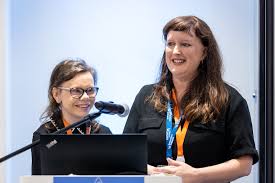
In this conversation Tamara and Derval talk about the significance of inclusive education for people with intellectual disabilities. Tamara shares her journey with us, while emphasising the need for equal access to education and employment, more inclusive workplaces, schools, and communities, and the importance of advocacy and awareness-raising efforts. Derval shares Inclusion Ireland’s aspirations for inclusion, and practical steps that can be taken by to achieve this.
Resources from this episode
Transcript of this episode
SUMMARY KEYWORDS
inclusive education, Inclusion Ireland, intellectual disabilities,
SPEAKERS
Derval McDonagh, Tamara Byrne, Mags
Mags 00:00
Welcome to talking about all things inclusion, a podcast where I where I get to meet and learn from people in the field of inclusion, in its broadest sense, that inspire me. I hope they’ll inspire you too. Today, I am talking with Derval McDonagh and Tamara Byrne, both who are coming to me from inclusion Ireland. Tamara is a self advocate from Dublin. She has advocated for people with intellectual disabilities nationally and internationally. She’s a member of the European Disability Forum Youth Committee, and is passionate about speaking up for her rights and for others who don’t have their voices heard. Tamara is particularly interested in equal access to education and employment. Derval is a senior leader in the not for profit sector in Ireland, having trained originally as a speech and language therapist, Durval has held many varied roles in her career, including Chief Operations Officer at a large service provider and now a CEO of Inclusion Ireland. The team at inclusion Ireland work towards the full inclusion of people with intellectual disabilities by supporting people to have their voices heard and advocating for rights under the United Nations Convention on the Rights of People with Disabilities. The UN CRPD. Derval is a board member with the Irish Penal Reform trust. She was appointed by Minister rabbit to the disability stakeholders group, by Mr Donnelly to the regional health areas advisory group. Derval is a firm believer that our workplaces, schools and communities are better when everyone is included and belongs. She and her team work every day towards a fairer and more equitable society. Derval and Tamara, I’m aware of the amazing advocacy and awareness work that you do within inclusion Ireland and outside, as seen in your bios, and that is why I am so delighted to be chatting with you today about the work that is happening in this area, and it’s such a broad, broad area. So I’m going to start with a really broad question. Why is inclusive education important to you and to inclusion Ireland,
Tamara Byrne 02:18
Am it’s important to me because we want to get more people involved for inclusion Ireland, and we want to get more people into education, and we want to get more people into college, and we want people to pursue their dreams and achieve their goals in life. And I think that’s really important, because if you’re a self advocate and you’re speaking all over Ireland and all over Europe, that is a really good thing to be doing, as well as going to school and learning education and see what you want to do after school, like go to college or, you know, try and get work experience or get a job, because they’re important things that we need to have as well as, you know, get going to these speaks and talk and then tell your story, and, you know, all these things, yeah. Oh,
Mags 03:13
do you know what I love that you said there Tamara, pursue their dreams and achieve their goals. Because isn’t that what everyone in society wants. And if you don’t mind, I’m going to come back to you in a minute and ask you how you’re doing that. But Derval, in terms of that big question, why is inclusive education important to inclusion Ireland and your work?
Derval McDonagh 03:34
Yeah. And I think Tamara has answered that so beautifully. Um, because Tamara has walked this, walked and lived this. You know, through her her life and your experience, Tamara has been about, you know, fighting for basic and equal rights with other people, your peers and your friends and your brothers and your sisters. So I suppose that includes in Ireland, our whole story is about supporting people to speak up for themselves and to challenge where things are not working for people, where things are unfair, unequal or not right, and we see that education is one of those spaces that really needs a lot of support to move in the direction of travel, of being fully inclusive. So like our entire constitution, our purpose, our strategy at Inclusion, Ireland is all about. The United Nations Convention on the Rights of People with Disabilities. With Disabilities. That’s where we take our lead from. And in that convention, which Ireland finally ratified, we did a wonderful thing. Finally, it took a long time in 2018 to sign up to that convention, and that really is very clear about the direction of travel, which is that we should have a time in our society that all children get to go to school together. And I suppose we see the unfairness every day through people contacting us, children and their families getting in touch with us and telling us their stories about having to travel an hour and a half to just go to school. Every day, we have moms and dads expressing to us that they’re having to apply to 40 or 50 schools just to get a place for their child. And and we really like I suppose, even if you’re to visualize how that works within a family, you know you have a mum or a dad or a mum and dad making the lunches in the morning, two siblings are going at the front door, turning left and going to the local school with their siblings, their with their peers and their estate, and getting the joy and the benefit of going to school locally, and the third child, because they happen to have an intellectual disability, is getting into a taxi at the at the bottom of the drive and traveling for up to an hour and a half to go to school. So we see this every day, and we just think at this stage, we need to be really serious about our commitment to the UNCRPD, and really serious as a state and a culture and as a society of moving towards a more inclusive model of education,
Mags 05:45
yeah. And as you’re speaking there, Derval, it’s actually quite sad that the picture you have painted is the picture that I saw growing up with a sister with an intellectual disability. I went one way. She went the other. I had my junior cycle, my leaving cert, my college results, put up for everyone to see, and she had the tokenistic, well done certificate that the school had to create because there was nothing else for her. So Tamara, you’re you’re an inspiration, even to me, because I’ve had that experience of education, yeah, and you are before 2018 so you’re before the convention was ratified, and you have carved out a successful path for yourself. Yeah, I would just, I would just, I would just love to sit back and listen to you tell me about your journey.
06:45
Well, first I my parents, my mom had to fight for me to go into education like everyone else, going same school as everyone else. She didn’t want me to go to anywhere else but same school as my sister and their friends and the friends I grew up with, but then when I left school, I had depression and anxiety. And I think depression anxiety makes your world, you know, like, horrible, and it’s upsetting for people to have them things in their lives when they’re finished good like me as a teenager, finishing school, going through like in my 20s, like that, was really difficult. I had to go to a day center, and I didn’t like going there, because I experienced a lot of bad ehm things in there that I didn’t want to see. Like I had depression, I had anxiety, and I needed to find a way for me to fight go to college like everyone else. And I did, my mom and all fought for me to go to college and without my mom and my sister and everyone else that I wouldn’t be here today talking to you or talking to anyone you know. So it’s really good that we have this conversation together. And I think it’s good that us women are really powerful, and we have these thoughts and our feelings in our heads that we want to play. You know is that’s really good.
Derval McDonagh 08:16
And Margaret, can I just say that? You know you speak about so beautifully, Tamara, that time when you were 16 or 17, and you were noticing that all your friends were hearing from career guidance counselors and from families about college and about further opportunities and what was happening with youTamara
08:35
And I was the one that didn’t get listened to. I felt like I was in the dark and no one to talk to, or felt alone. And it felt like, Am I good enough for people? Am I worthy enough to go to college? Am I strong enough to go to college? You know, all these things in your head, and I always say to people, don’t bottle you’re feelings in, Just say what you have to say, and you feel better about yourself and good enough about yourself. Because there is these people out there that say that, Oh, you’re not good enough, or you’re not you’re not this, and you’re not that. They’re wrong. They don’t know what you’re going through on a daily basis. You don’t know your struggles, or, you know, all that kind of stuff,
Mags 09:25
yeah. And do you know it’s quite sad that, yeah, what I’m hearing is your main challenge was that nobody listened, nobody saw you, nobody believed that you could and look at you now like nobody, nobody went, Oh, no, Tamara can do that was like, No, Tamara can’t. And that’s even before anyteaching happened.
Tamara Byrne 09:51
Yeah, yes.
Mags 09:53
So what did that mean for you in terms of learning, if nobody was listening to you or nobody believed outside? Mom or mommies or heroes, but what did that mean for you when nobody believed you could become who you are?
10:08
I felt like, you know what, if people don’t listen to me, why am I? Why am I keeping myself saying these things when people don’t listen to you and you, they think you don’t feel good enough to do anything in your life, and you see all these people putting you down just because you have a disability. Forget about the disability. See ability, which I use all the time, and see what we can become when like you, we need to sit down and have these conversations like normal adults, and grab the bull by any horns and nip it in the bud, because there is people that don’t listen to you, and it’s going to get worse and worse until you say I had enough. I need to let this person listen to me and make me feel valuable of what I’m saying andvewhat I mean, you know, yeah,
Mags 11:04
and do you know, like, I hate that you even have to say I’m like you and normal adults, you, we shouldn’t even have that language today. And Derval, I’m wondering, then, in terms of all of the the parents and children young adults, who are contacting you, is this where it all starts for them as well, the not being seen, the not being heard, the being less than others
11:30
Absolutely. And you know, I think Tamara is such an wonderful advocate who has learned to use you’ve learned to use your own voice tomorrow, and you’ve learned to speak up for others, and it’s often compounded for people who are in our education system, who maybe are non speaking or non verbal, or who might use technology to communicate how they get their their message heard and their voice their voice heard and their voice understood, is incredibly challenging as well. So yes, I believe it starts very early. The messaging that we give children and young people, it starts really, really early. We start talking to people like that they have problems that need to be fixed, as opposed to actually the world needs to resolve this, to be more inclusive. So we start putting the burden on people and saying that you need to be better. You need to speak up more, you need to figure this out, whereas actually it’s us, it’s it’s the whole of society that needs to figure out what these barriers are and start removing them. And that’s why I really admire the work that you and other academics do around Universal Design for Learning, which is really about making all of our spaces and places more inclusive from the get go, so that everybody’s welcome, and everybody has a chance to belong. And then we also recognize that within that there might be individual accommodation needs that people have, and they should be valued and recognized too. So Tamara speaks beautifully about, you know, one of the biggest barriers being accessible information and communication, and we just see that as a cornerstone for accessing anybody’s human rights. And our schools need to, you know, be equipped and understand the role that communication and accessible communication plays in in including children and young people and also the net, the negative language that we just find ourselves speaking like we are constantly talking about. Let’s not talk about units. Let’s not talk about separate let’s not talk about other difference. We we recognize and value difference, but that is a strength in our education system, and like what we you know, earlier you asked the question about why inclusive education is so important. We think it’s important for every child. Sometimes it’s seen as this kind of niche thing that is about children with intellectual disabilities being included, but actually the things that we are asking for and demanding and looking for from our our education system will actually benefit every child who doesn’t want highly skilled teachers who can can be really flexible and adjust to meet the needs of every child who doesn’t want to be in a classroom with kids who think in different ways and learn in different ways and, and, you know, who doesn’t want a society where children are coming out of school valuing and respecting difference? So, so I think we need to take the conversation away from a niche issue and make it about building just a better system for us all. And, and if any of us think back on our experience at school, you know, we had great experience, positive experience with wonderful teachers who who saw us and valued us and heard us. And and then there’s quite a lot of people who had very, you know, negative experience as well, where they weren’t seen and valued and heard. And we just need to unpick that and understand what that’s about, and give the schools the tools that they need, give families the trust that their child will be supported well in the local school, and start building a better model for everybody. Absolutely,
Mags 14:51
and it’s about, it’s going on. Going back to Tamara’s earlier comment about, you know. Know, being given basic rights, and every child, every adult, has basic rights. It’s not that there’s one set for one and one set for the other, and it’s about you talked about pursuing your dreams, but if all those barriers are in front of you, how can you do so and like, that’s what I’ve talked to my students about. So I I tell them that they know I’m a bit quirky, so it’s okay, but I actually tell them that every student in front of them is a jar of magic, and it’s their job to loosen that lid, not tighten it. Yeah, that’s what it’s about. That lid is a barrier. Get it off.
15:33
Yeah, exactly, yeah. And there needs to be more that. Like, you know, when you ask for something, you have to have that in your hand. Or if you wanted help, like, I ask for help sometimes, and I need help, it’s okay to ask for help. You shouldn’t be ashamed of yourself or letting yourself down just because you’re asking for help. If you need help, ask for it. Don’t leave it too late. Don’t keep anything involved in I think, is the key. And trusting each other as well. It’s really good that you have trust people with you, you know, take you on the journey, like, during the same journey as you you know, it’s really good that I can work with Derval and all the all the colleagues in Inclusion Ireland, they help me a lot as well, anyway, because I’m really happy that I get to go to these places and speak my story and tell my purpose in life, you know. And it’s really good. And I think there’s more people like that out there. And
Derval McDonagh 16:40
just to say, I think we help each other, you know, I think that what we try and do and we just, I think we really normalize asking for and receiving help from each other every day. You know, there’s things that I struggle with that I need help with. This. That’s what being human is all about. But, um, yeah, so I think that kind of, I, Tamara, you’re so right on that that kind of, you know, there’s no shame in asking for help. But unfortunately, having to ask for it over and over again is a position that people find themselves in. So wouldn’t it be great if you didn’t have to ask, because the system was just set up to include you in the first place, you know, absolutely. And I’d include in Ireland sometimes where, you know, because this can be, you know, a delicate conversation to have about inclusive education. And I think we’re really clear on that at inclusion Ireland, we’re not here to judge or, you know, any choices that children and families have to make on a daily basis about where they send their child to school or how they access education. Because, you know, it’s the system really that needs to change, not the children, not the families. You know, I think when you get in a room together and have a nuanced conversation about inclusive education, it’s not as polarized as it might seem. I think we all want the same things. It’s just that we haven’t built trust in the system yet that this is a definite journey we’re on that’s going to be properly resourced, properly taken care of. So then, of course, there isn’t trust in it. Families feel burnt by the system. Teachers and educators feel burnt because they’re not getting the resources and the training and the help that they need. So we continue to not trust it, and therefore we conflate that with not trusting inclusion. So I think there’s a big conversation we need to have about building that trust over time and looking for that kind of plan and leadership from government and people in decision making positions to create that plan with us. Yeah, for the next 10 years.
18:37
Yeah, and especially like governments need to stop taking away money from people. They need more education to be put in. They need more speech therapists. They need all this kind of stuff. And they need to take into consideration and what as well. There’s homeless people sleeping on the streets, and they’re not getting the help they need. So if I was the government, I’d take care of all the homeless and put people into skills and get more education instead of staying at home. That’s okay if you want to stay home. But if it was me, I’d go to school and then go to college to further my education. You know that kind of way,
Mags 19:22
absolutely, and maybe because we stopped talking about your journey when you mentioned you were in day services. I mean, what a name for a support service for young adults. Day Services, yeah, but moving on from day services, what was your college experience like? So you’ve talked now about the need for education. Need to get up and go out there. Yeah, I’m hoping it was a positive experience for you. I’d love to hear more
19:50
it was and it was really going because then my first year was kind of like a bit shy, and I didn’t know where it was going and where it was going to and. All that kind of stuff. But then I got used to it, and it got better and better as I went along in college, and I done my own radio show. I co hosted it and presented it, and I done different topics. I done the topic about medieval Irish history, which I’m passionate about, because I done a lot of history in school. And I said to myself, You know what, one day when I got to college, I’m going to do more and more about medieval Irish history. And this time, it’s very, really good. And I enjoyed doing them. And you know, there’s those nights you can go out in the college as well. That was really cool. But the most importantly thing was the um assignments and the lecturers were really helpful and really kind, you know, because that’s what you want to have in your college experience. Just go into college, have a good time and learn from you know, your friends or your family or your lectures, because if you’re sitting in lecture and you’re not interested, well, why you’re sitting in college if you’re not interested? Because I was in college and I saw these people on theor phones and on their computers. And I was like, why would you even go to college if you’re not interested in that? You know? Yeah, so kind of, like, I was kind of like, mad at them, because they’re sitting there on the computers, they’re playing these games, and they’re not even taking into consideration that the lecture has come in and he’s kind of like wasting his time telling them these things, and they’re not opening their ears and listening to what he’s saying. And
21:53
maybe that’s because you had to fight so hard to get to Maynooth University and to to follow your dream and pursue your passions that, yeah, you see it as a great privilege to be able to do that.
21:54
And yeah, it was really good that you got to go to college, and you got to meet new people, and you got to make new friends, and you’re on the same journey as well. So it was really good.
Mags 22:15
I’d love to know when did you decide that you wanted to speak, not only for yourself, but for others. Where did the advocacy idea start into a reality for you?
22:33
It started in college, because I didn’t know about human rights or equality back then, but when I went to Inclusion Ireland, and we did lots of projects in college, that’s how we knew about human rights and equality, and I was like, what if I can do this to help people speak up for themselves? Because I think some people want, don’t want to speak up because they think that they’re not good enough, which they are, you know, that kind of way, and they feel like they don’t want to tell their stories, to want to keep them to themselves, because we all been through stuff that we never want to go through in the first place, and we all go through this journey where there’s people that want in their life, and, you know, want you in their life, you know. So that’s kind of like what I went through, you know, but I got through it and a better person today and tomorrow. And every single day, when I wake up, I feel like, yes, I want to go to work. I want to go to my job. Want to feel happy, you know, want to see the girls in the town and what growth to, you know, yeah,
Mags 23:46
so again, going back to those basic and equal rights that you talked about at the beginning. And Derval, you talked about what you’ve seen, being unfair, unequal and not right. And you mentioned the United Nations Convention for the Rights of Persons with Disabilities. And yes, we ratified it in 2018 but in 2019 we were told by organizations here in Ireland that we were in contravention of Article 24 the education article. So we’re still not there, and I would love to know what you feel with all of your expertise with children, young adults, their parents out there, with other communities, what is needed for us to achieve inclusive education? And I know there’ll be the big aspirations, but I also know you very concrete if we did this.
24:39
Yeah, so yeah, I might start with the big aspirations, and maybe it’s just something that we observe that is really needed in this space. So as I mentioned earlier, it can be seen as quite polarized or challenged, or, you know, parents versus schools, or schools versus this, or, you know, but actually, when we get together there, there is that kind. And vision. You know, it’s just how we get there, is the thing. But what we really need in that space that can be divisive is real clear leadership. So we really need to see our government and our ministers stand up for inclusive education. We need public statements about what that is and what that means, we need to understand that in that there will be difficult conversations to be had, there might be feedback from people who are fearful, but we need to be brave about that and have that public conversation wholeheartedly and honestly. And I think to back that up, then to build trust in the system. We need a 10 year inclusive education plan that is like a slaunter care for education, you know. So it’s cross government. No matter who’s in government, they have signed up to it so people can start believing and seeing that change is possible. Things will get incrementally better next year, the year after and the year after that. And that’s the only way to take that fear, uncertainty, divisiveness out of the system, because everybody needs to build trust in that schools, families, children, and so I would say that 10 year plan is the most important piece, after leadership and courage. And then the third piece that I think is absolutely critical is the voice of the child and the young person. We simply don’t hear enough about children’s experience in school publicly, and we don’t have enough of children with intellectual disabilities being at the table where decisions are being made about their current education system and the future education system for their peers and the children coming behind them. So we really need the voice of the child to be, to be at the center of this, and that’s what brings people together, actually. So we, you know, we have given feedback to the department there is the EPSEN review. Is obviously things are under view at the moment with the legislation, we sit on the advisory group for that, and we that is one of our most, I suppose, our strongest recommendation is that children need to be listened to. They need to be given additional weight in the review of the legislation, because they are really the experts by experience. They know what they need, and children are natural born includers, and it’s actually the adults who teach children to be exclusive and to and to to not include other children, whereas children naturally know how to respect and value difference. We just need to set up that kind of supports around them. So I guess there are top things really, one, leadership, two, a 10 year plan that everybody can buy into. And three, the voice of the child, loud, clear and Central, absolutely.
Mags 27:47
And you know something I’m always talking about, value and public visibility, and if our leadership, if our government, don’t publicly come out and say we value this and put the actions in place to prove they value respect difference, then it’s never going to happen, and we’ve seen this happen before. So before I return to Tamara durville, I’d like to ask you one other question in this context, because I know you’ve read the policy advice paper that came out last week. Do you think this is going to help the journey? Or, yeah,
28:27
absolutely. I we welcome the publication of the advice, because we’ve been calling for its publication for quite a number of years, and we’ve realized that it has taken some time to get here, however, and just to add to that, we do need to see now a nuanced conversation around it, because landing 146 page documents on the public without a proper discourse and conversation that is inclusive, accessible and compassionate will lead to fearful responses from everybody, of course, and that is only typical, you know. So I think while we welcome the policy advice, it’s the method for bringing everybody on the journey that is the issue. So we want to see really concrete actions coming from the National Council for Special Education, coming from the department about having public conversations, bringing people on this journey, taking the fear out of it. For people, there’s going to be no closures of anything, should mean that we are going to be evolving over the next number of years towards a more inclusive model of education, and people need to be respectfully brought on that journey, you know. So, so that’s our big issue with the policy advice, not the advice itself, because it does talk all the right language about being in line with uncrbd and moving in this direction and evolving towards inclusion, but it’s the nuanced conversation that needs to be had with people who are fearful and rightfully worried Absolutely,
Mags 29:57
and I’m glad you talked about that nuanced conversation, and earlier you talked about clear public statements, because a principal, friend of mine, who is very inclusive, I mean, her goal is to have an inclusive school contacted me and went but this is just for special schools and special classes. Where am I in it? And I because I’d gone through it, as you said, there’s a lot in there, I like initially said to her as a mainstream principal, you need to read between the lines, because they’re not telling you where you are in it. So it’s really interesting that you’ve brought it back to that nuance, that concrete and those clear statements. And Tamara, that brings me back to you, and I’m looking at the visuals behind you on the wall, and it’s everything that you it’s amazing. I wish people could see this, but it’s everything that you’ve been talking about in terms of your journey, in terms of needing people to look at you and others with disabilities in a positive light, to look at what you can do, and to have that trust and to get rid of the fear. Was, this was part of a round table discussion. I can tell can you? Can you tell me about us?
Derval McDonagh 31:08
And so this is the conference, yeah, that we had remember, and you spoke at us for Inclusive Education. Yeah, for inclusive education.
31:15
You see here all the different words and different meanings and different drawings on the board here. And I think the stand out for me is meaningful, and I think that if you’re telling your story, it feels like you’re telling it in a meaningful way, and people understand you when they get you, and they know where you come from, and they take you into consideration, to take you into account. You see these people that listen to and don’t think you’re good enough or valuable enough. I think that’s really unfair for a person like me or anyone else that goes through life and goes through days when you have these bad days and you just feel like you want to talk to someone you know, you can’t just say no to a person and then say, Oh yeah, get you now. It doesn’t work that way. It’s not good enough. It doesn’t work that way for me or anyone. I don’t think you know, but being included is the other as well.
Mags 32:19
And it comes back the words that is jumping out at me there is the mindset shift. And I think that this whole conversation is about that we need to stop looking at what people can’t do or what we think is wrong with a person, yeah, what we think is the level they can get to, yeah, and start thinking like, you think tomorrow, yeah, like, I can do it, and everyone can do it, yeah, if we’re given the chance and supports that we all deserve,
Tamara Byrne 32:51
definitely. And I think you’re saying it well as well, that we need to have these chances, and people need to believe that we’re not robots, we’re human beings like we’re not going to be put down in a box, and we need to stop them, people trying to to take away that we want to have a good life and we want to have a good day. Yeah, we have bad days, and we go through them. You know, tomorrow’s a different day. There’s light at the end of the tunnel, which I always say, you know, get shared the light and see what’s behind the light. You know, absolutely,
Mags 33:30
and you’re leading. You’re leading the way like we were talking about your role as an advocate. But I’m sitting here having this conversation, and I’m thinking of the missed opportunities of my sister, yeah, and I’m thinking of when other people with disabilities are in a room and they see and they hear you speak, that you are going to be giving them the message that they can do it too. And I think that’s a huge part of advocacy, is that we’re modeling, and we’re showing not only the people who think we can’t do it, yeah, but the people who are made to believe they can’t do it because others are telling them, and you’re proving them all wrong,
Tamara Byrne 34:12
yeah. I think that, you know, when I speak about these things, that I think that people think, oh, tomorrow’s not doesn’t know anything. When I do know, I know a lot of things, but you know, you know, take my take my point, take take my view. You know, it’s good. Yeah, I’m glad that we have these conversations scattered. You know, as women, as women that are falling for each other, you know, against people that don’t miss them and be mean to them or bullying them. I think it’s really Golda, you know, three women can do this gathering. You know, absolutely,
Mags 34:55
but what gives like myself and Derval could have and this is what I love about Inclusion Ireland. Is that it’s true advocacy myself and Derval could come on and have a conversation and talk about the experiences of others, yeah, but they’re not our shared experience. You are out there saying, This is my life, this is my world, yeah, and this is what the world needs to do to remove barriers,
35:18
yeah, to remove barriers and stop discrimination, because there is people that get bullied in school and and you know, their family might not accept them for who they are, or anyone like that. I’ve been through that like there’s people that don’t accept me for who I am. They treat me like a child, not as an adult. And I could say, why don’t we sit down and talk about this, instead of keep going round circles? If you’re not going to accept me, then that’s that’s not good enough for me. It might be good enough for you, but I am who I am, and take it or neither
Mags 35:58
you are. So Right? Can I jump? I’m going through a wave of emotions as we’re having this conversation. I’m going for, from anger of what wasn’t there to hope for what is there to just this sense of like, wow, there are strong women with disabilities out there breaking down barriers for others. And like Derval, I’m forgetting about you with this stage, Tamara.
Derval McDonagh 36:24
Please do forget
Mags 36:25
I’d love to know about you but we are coming close to the end of this, so I’m just wondering, is there any link or article or resources that that you would share with other people, whether it’s to do with advocacy or or just where they can get some help, whether it’s for their well being Tamara, because you’ve spoken so well about well being, whether it’s their education, whatever it is, yeah,
36:53
so I guess at Inclusion Ireland, we have, we have a phone line so people can actually call us, and we provide, you Know, a signposting and Information Service for children, for adults with intellectual disabilities, and for family members. So we get, we get calls from from the public every day of the week looking for advice, support resources. Our website, inclusionireland.ie has a lot of information about rights and entitlements and education that might be useful for people to check through. And we recently published a report based on the lovely artwork you see behind us here, and a conference that we held called the pathway to inclusive education. And we had fantastic support for the development of that report. So we had the Chief Commissioner of IREC gave us a statement. First, was very involved in the conference. We had the ombudsman for children. We had many advocacy organizations. Individuals with intellectual disabilities and family members contribute to it. So it’s a real, I suppose, insight into who we are at inclusion Ireland, what we’re trying to achieve together collectively in a nuanced and respectful way, as we walk this path together, recognizing It’s tough. It’s challenging, you know, but we’re in this space for the long haul, until every child can get to go to their local school with their siblings and peers. We won’t rest. So I think that, I think that report ties that together with some really practical recommendations for government, for people in power, and also for people working in their local school, the most amazing teachers, educators and SNAS who are out there every day of the week trying to make inclusion work in the best way that they can. So it’s a kind of resource for them as well. So yeah, I draw your attention to that on the website too. Yeah.
Mags 38:38
I’m glad you said that, because a lot of people will skip over inclusion Ireland if it comes up on a field on your your screen, if you’re doing a search, because they think it’s just advice for the people and the parents of people with intellectual disabilities. But as you said, it’s a resource for everyone, and there’s some brilliant supports for teachers. That’s
Derval McDonagh 38:59
it, and I suppose one of our big this year, and with Tamara’s support and other advocate support, our main campaign this year is on inclusive education, and what we’re trying to do is to reach out and support as many schools as we possibly can. So we ran a first in a series of webinars just before Christmas on sensory spaces in schools, and kind of debunking some of the myths around that, and we were overwhelmed with the response from teachers, educators, SNAS across the country. So we really see how we can support children is by supporting schools to be more inclusive. So we’re really going to focus on that this year. So we’d love people to get in touch with us. We are dying for teachers, SNAS to get in touch with us and people working within the education system, because we really feel this is about building an Alliance, an alliance for change, and we can’t do this on our own, and there’s plenty of people out there who want to connect and work together on developing a better education system. So we are all ears. We’ve opened hearts and minds, and we want to work with you all, so please do. Um, we
Mags 40:00
are coming to the end. I mean, I could start talking. So I’m gonna ask you Tamara to give any final words, because we should end on your voice. Any final words, um,
40:13
thank you for having me, and hopefully we meet each other again soon, and for me. Anything else? Some hesitate to ask me, you’re terrible for anything else. Thank you so much for having us here today, and hope this serve and when you go look and inspires you.
Mags 40:35
Thank you. This was brilliant. And do you know something, the fact that your final words are an offer of help. Yes, shows who you are and what you were doing. And I think that’s the perfect note to end on. So I’m going to say goodbye to everyone. Thank you so much for joining myself, Tamara and Darville for talking about all things inclusion. And I hope you will all join me again soon. Thank you again. So so much Tamara and Derval for sharing with us today. This has been one of the most inspiring conversations I’ve been part of, part of recently. Thank
41:07
you so much today. Thank you, Margaret. Thank you, Margaret. Bye.
 Equity In Mind